Otology · Free article
Sudden sensorineural hearing loss: recognition, referral and treatment
Sudden sensorineural hearing loss for FRCS (ORL-HNS): the definition, NICE referral timings, ruling out a conductive cause, MRI, steroids, salvage treatment and follow-up.
What counts as sudden sensorineural hearing loss
The definition used in most trials and in the American Academy of Otolaryngology–Head and Neck Surgery guideline (2019) is a sensorineural loss of at least 30 dB across three consecutive test frequencies, developing over 72 hours or less. The guideline notes that looser criteria are often used in practice, and that a loss is idiopathic when no cause is found despite adequate investigation — which is the case for the large majority. It is usually unilateral, often accompanied by tinnitus and aural fullness, and sometimes by vertigo.
It is an emergency because treatment is thought to work best early. NICE NG98 recommends referring adults with sudden hearing loss not explained by an external or middle ear cause immediately, to be seen within 24 hours by an ENT service or emergency department, if the loss developed over 3 days or less within the past 30 days. If it developed more than 30 days ago, or the hearing has worsened rapidly over 4 to 90 days, the referral is urgent — to be seen within 2 weeks by an ENT or audiovestibular medicine service.
Step one: is it really sensorineural?
The guideline’s first strong recommendation is to distinguish sensorineural from conductive loss when the patient first presents. Wax, otitis media with effusion and a perforation all cause sudden-seeming deafness, and none of them needs steroids. Examine the ear, then use the tuning forks before the audiogram is available:
- Weber (512 Hz): in a unilateral sensorineural loss the sound lateralises to the better ear; in a conductive loss it lateralises to the affected ear.
- Rinne: air conduction is heard better than bone conduction (Rinne positive) in a sensorineural loss.
- Tympanometry: a normal type A trace supports a sensorineural cause; a flat trace with normal volume suggests an effusion.
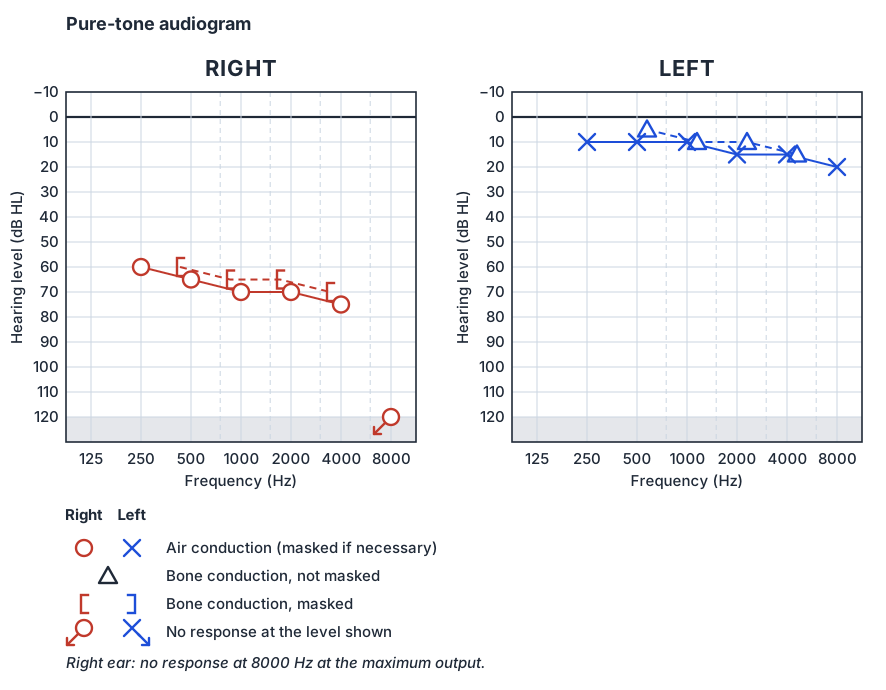
Pure-tone audiometry with appropriate masking confirms the type and degree of loss and is the baseline for judging recovery. The audiogram below shows the typical pattern.
Step two: look for a cause
The 2019 guideline recommends assessing every patient for bilateral sudden loss, recurrent episodes and focal neurological findings, because these point away from the idiopathic diagnosis. Causes to keep in mind include:
| Group | Examples | Clues |
|---|---|---|
| Retrocochlear | Vestibular schwannoma; multiple sclerosis | Asymmetric loss, poor speech discrimination; other neurological symptoms |
| Vascular | Anterior inferior cerebellar artery infarction | Sudden loss with vertigo and cerebellar or brainstem signs — a stroke until proven otherwise |
| Inner ear | Ménière’s disease; perilymph fistula; autoimmune inner ear disease | Low-frequency, fluctuating loss with vertigo; onset with barotrauma or straining; bilateral, progressive loss |
| Infective | Viral labyrinthitis; syphilis; Lyme disease | Vertigo with the loss; risk factors and other features of the infection |
| Trauma and toxicity | Temporal bone fracture; aminoglycosides and platinum chemotherapy | History of a head injury or ototoxic treatment |
Investigation is directed by the history. The guideline makes strong recommendations against routine CT of the head and against routine laboratory tests, and recommends evaluation for retrocochlear pathology. In the UK that means MRI of the internal auditory meati: NG98 recommends considering it for adults with sensorineural loss and an asymmetry of 15 dB or more at any two adjacent test frequencies — which a unilateral sudden loss will nearly always meet — and MRI is indicated regardless of thresholds when there are localising signs.
Step three: treatment
- Systemic steroids
- The usual first-line treatment, best started early. The 2019 guideline makes it an option, offered within 2 weeks of onset after discussing risks and benefits. The oral arm of the STARFISH trial — prednisolone 1 mg/kg/day, up to 60 mg, for 7 days — reflects common UK practice. Ask about diabetes, peptic ulcer disease, psychiatric illness and infection before prescribing, and monitor blood glucose where needed.
- Intratympanic steroids
- Steroid injected through the tympanic membrane reaches the cochlea in high concentration with few systemic effects. The 2019 guideline recommends it as salvage when recovery is incomplete 2–6 weeks after onset. A Cochrane review (2022) found that, as primary treatment, intratympanic steroids may make little or no difference compared with systemic steroids, and that as salvage they may increase the number of people whose hearing improves — but the evidence is mostly of low certainty. Pain, dizziness at injection and a persistent perforation are the recognised side effects.
- Hyperbaric oxygen
- An option in the 2019 guideline only when combined with steroids, within 2 weeks of onset as initial treatment or within a month as salvage. Access in the UK is limited.
- Not recommended
- The guideline recommends against routinely prescribing antivirals, thrombolytics, vasodilators or vasoactive substances.
Situations that change the plan
- Sudden loss with vertigo and neurological signs: an anterior inferior cerebellar artery stroke can present this way. Examine for cerebellar and brainstem signs, and treat it as a stroke pathway problem rather than an ENT one.
- Bilateral or recurrent sudden loss: idiopathic disease is rarely bilateral. Think of autoimmune, infective, vascular and neoplastic causes, and of Ménière’s disease when episodes recur with vertigo.
- Diabetes or other reasons to avoid systemic steroids: intratympanic steroids avoid most systemic effects and are a reasonable first-line route; involve the diabetes team if systemic steroids are given.
- The only hearing ear: treatment is more urgent, and early audiological support matters, because the patient may be left with little functional hearing.
- Onset with barotrauma, straining or head injury: consider a perilymph fistula or temporal bone fracture, which change both the imaging and the treatment.
Prognosis and follow-up
Some patients recover without treatment, and recovery is more likely when the loss is mild or confined to the low frequencies. Profound loss, vertigo, older age and delay before treatment are generally associated with a worse outcome. The 2019 guideline recommends audiometry at the end of treatment and again within 6 months, and counselling about rehabilitation and support for anyone left with hearing loss or tinnitus. For a persistent unilateral loss, the options include a conventional hearing aid where there is usable hearing, and CROS aids or bone-conduction devices for single-sided deafness. The MRI result also needs to be followed up: a vestibular schwannoma found this way enters its own pathway of surveillance or treatment.
Frequently asked questions
How quickly should sudden hearing loss be seen?
NICE NG98 recommends immediate referral, to be seen within 24 hours by an ENT service or emergency department, when the loss developed over 3 days or less within the past 30 days and is not explained by an external or middle ear cause.
Which way does Weber lateralise in sudden sensorineural hearing loss?
To the better (unaffected) ear. In a conductive loss it lateralises to the affected ear. A severe loss can give a false-negative Rinne because bone conduction is heard by the other cochlea.
Does every patient with sudden sensorineural loss need an MRI?
UK practice is to image the internal auditory meati to exclude a vestibular schwannoma. NICE NG98 recommends considering MRI for an asymmetry of 15 dB or more at two adjacent frequencies, which a unilateral sudden loss nearly always meets, and the 2019 American guideline recommends evaluation for retrocochlear pathology.
When are intratympanic steroids used?
Most often as salvage when hearing has not recovered fully after systemic steroids; the 2019 guideline recommends offering them 2–6 weeks after onset. They are also used first-line when systemic steroids are contraindicated. The best first-line route is being studied in the UK STARFISH trial.
References
- NICE. Hearing loss in adults: assessment and management (NG98). 2018.
- Chandrasekhar SS, Tsai Do BS, Schwartz SR, et al. Clinical Practice Guideline: Sudden Hearing Loss (Update). Otolaryngol Head Neck Surg 2019;161(1 Suppl):S1–S45.
- Plontke SK, Meisner C, Agrawal S, et al. Intratympanic corticosteroids for sudden sensorineural hearing loss. Cochrane Database Syst Rev 2022;7:CD008080.
- Smith ME, et al. Protocol for a multicentre randomised controlled trial of STeroid Administration Routes For Idiopathic Sudden sensorineural Hearing loss: the STARFISH trial. PLoS One 2024;19(2):e0290480.
- STARFISH trial registration. ISRCTN10535105.
Further reading
- NICE NG98: hearing loss in adults — Referral timings and the MRI asymmetry criterion
- AAO-HNS sudden hearing loss guideline (2019) — Key action statements on investigation and treatment
Written for revision in the FRCS (ORL-HNS) style under our editorial standards. It is not clinical advice: always confirm against current guidance. Spotted an error? Tell us.
Related articles
Basic science
Reading an audiogram: thresholds, masking and the patterns that matter
How to read a pure-tone audiogram for FRCS (ORL-HNS): BSA symbols and axes, degrees of hearing loss, the air–bone gap, the three masking rules and the classic patterns.
ReadBasic science
Tympanometry: reading a tympanogram
How to read a tympanogram for FRCS (ORL-HNS): peak pressure, peak admittance and ear-canal volume, BSA normal ranges, Jerger types, flat traces and the 1000 Hz infant test.
ReadOtology
The facial nerve: anatomy, localisation and House–Brackmann grading
The facial nerve for FRCS (ORL-HNS): its course from brainstem to face, the branches that localise a lesion, House–Brackmann grades I–VI, Bell’s palsy and the eye.
ReadTurn reading into marks
Drill otology with curriculum-mapped questions, rate your confidence, and watch the gap close on your dashboard.